
Literacy is Language
Build listening and speaking first. Reading and writing grow from there.
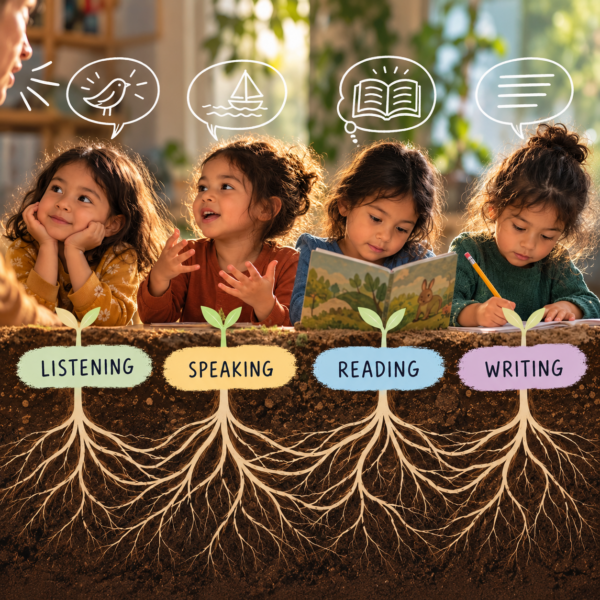
Ask most people what “literacy” means, and they’ll point to a shelf of books. But literacy doesn’t start on the page. It starts in the ear and the mouth.
Listening, speaking, reading, and writing aren’t as separate as they may seem. These are four expressions of one underlying system, split along two lines: receptive (taking language in) versus expressive (putting language out), and oral (spoken) versus written (printed).
Literacy begins with oral language. A child’s vocabulary, sentence complexity, and ability to track a spoken story are the soil that reading and writing grow out of. Strong oral language doesn’t guarantee strong literacy, but weak oral language reliably slows it down.
Is speaking part of literacy?
Yes — and oral language sits upstream of reading. That’s why a student can decode accurately and still lack full comprehension. The missing skill isn’t a reading skill — it’s a strong foundation of rich oral language.
What is academic language?
Academic language is the specialized, complex language used to acquire and express knowledge, operating at three levels:
- Word level: prefixes, suffixes, and other word-building patterns
- Sentence level: subordinate clauses and other complex sentence structures
- Discourse level: main ideas, story elements, and how information is organized across a whole text
Where should reading instruction actually start?
If you’re evaluating a literacy initiative, ask: does it treat oral language and academic language patterns as foundational, or does it start at decoding and hope the rest follows? The research suggests the rest doesn’t reliably follow on its own. It has to be taught.

Free Download
Download PDFRelated Resources

- PDF
Book Bridges: The Rabbit Listened by Cori Doerrfeld
The Rabbit Listened is a gentle and heartfelt story about a child named Taylor who experiences a difficult moment after something important to them doesn’t go as planned.
- PDF
Book Bridges: the tree in me by Corinna Luyken
Through poems, the tree in me tells a beautiful story that describes knowing that we all have something growing inside us. - PDF
Book Bridges: As An Oak Tree Grows by G. Brian Karas
As An Oak Tree Grows follows a small acorn that grows into a strong, mighty oak tree over the years. - PDF
Book Bridges: Corduroy by Don Freeman
Corduroy is about a little teddy bear living in a big department store waiting for someone to take him home and love him. - PDF
Book Bridges: Coat of Many Colors by Dolly Parton
In Coat of Many Colors, a young Dolly looks back at her childhood and thinks about a coat of many colors made by her mama out of a box of rags. - PDF
Book Bridges: Ten Ways to Hear Snow by Cathy Camper
Ten Ways to Hear Snow is the story of an Arab-American girl named Lina who learns to hear the world around her in unique ways.
